Social Innovation Observatory / SIO
Background and Objective
Social innovations are an integral part of the innovation landscape. They emerge wherever new social practices, organisational arrangements or collaborative models provide responses to societal challenges, for example, in education, healthcare, housing, mobility or digital inclusion. Despite their growing importance, there is still no robust empirical basis for systematically capturing how social innovations emerge, diffuse and generate impact. Unlike technological innovation, social innovation lacks both continuous monitoring and a scientific infrastructure capable of observing developments over time and enabling meaningful comparison.
The Social Innovation Observatory (SIO) addresses this gap. Funded by the German Federal Ministry of Research, Technology and Space (BMFTR), the collaborative project brings together the expertise of the Centre for Social Investment and Innovation (CSI) at Heidelberg University, the Institute for Work and Technology (IAT) at Westphalian University of Applied Sciences, and the Centre for SME Research and Entrepreneurship (ifm) at the University of Mannheim. Its aim is to establish the scientific and methodological foundations for the long-term monitoring of social innovation in Germany.
The conceptual foundations of the SIO build on the collaborative research project Impact of Social Innovation (ISI), conducted by the project partners between 2022 and 2024. As part of this project, a conceptual understanding of social innovation was developed that positions social innovation as an integral component of the broader innovation landscape. In addition, medium-range explanatory models were developed and tested that enable the systematic identification and analysis of social innovations through innovation fields, such as the sharing economy, digital learning, collaborative housing and blockchain. This approach is based on the premise that transformative change is rarely driven by a single innovation; rather, it emerges from bundles of mutually reinforcing innovations that develop within a shared field.
The overarching objective of the SIO is to establish a scientific monitoring infrastructure that makes social innovation in Germany continuously observable and enables its development to be tracked over time. In doing so, the Observatory will provide a robust and longitudinal evidence base to support research, policy-making and practice, while contributing to the further development of Germany's national innovation reporting system.
Approach
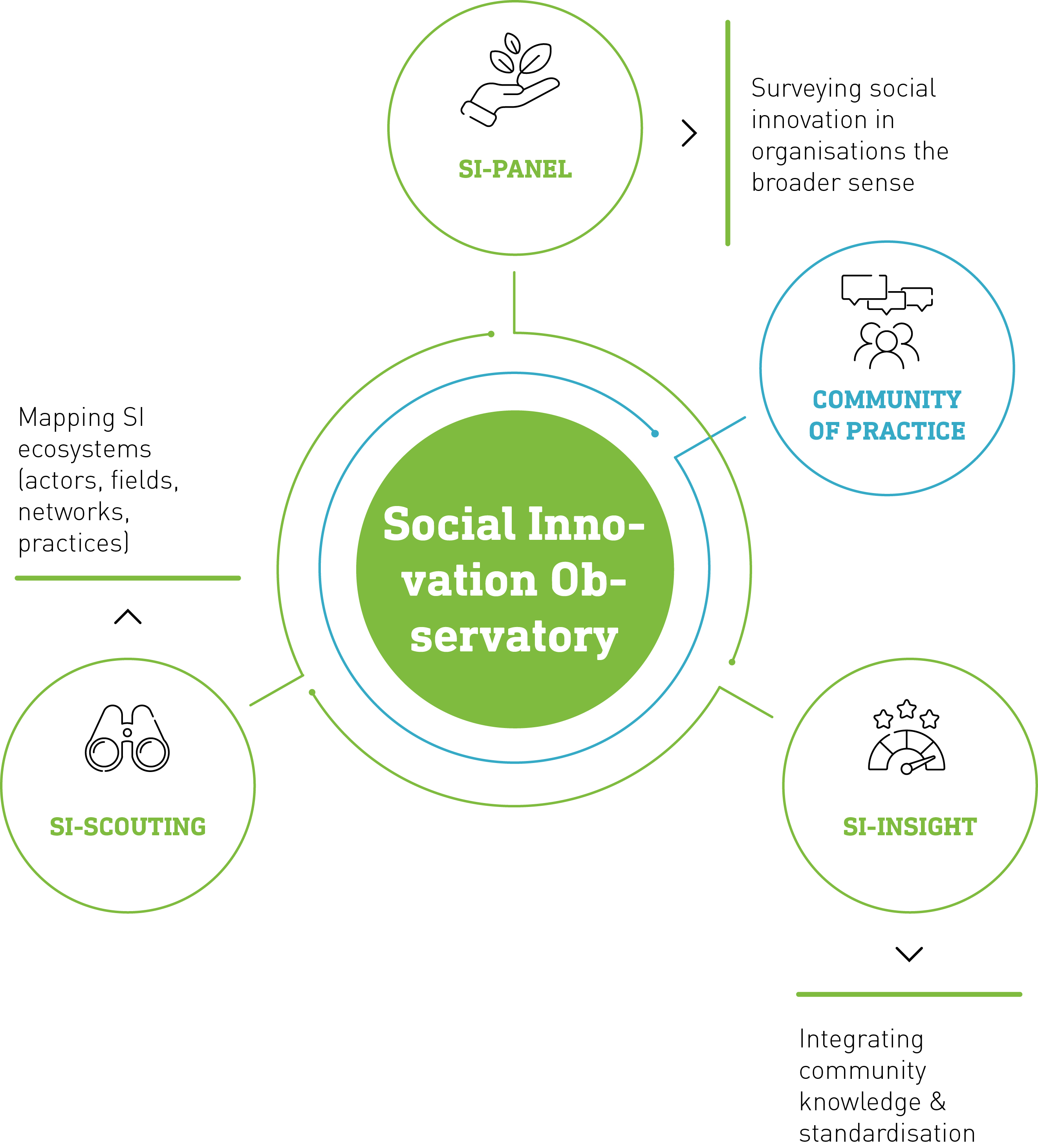
The SIO consists of three complementary components: SI-Scouting, SI-Panel and SI-Insight (Figure 1). Together, these components provide the foundation for the continuous observation of social innovation and its dynamics.
The SI-Scouting maps Germany’s social innovation ecosystem through continuous web-based observation. A web crawler identifies organisations and initiatives that develop or disseminate social innovations and analyses the digital connections between them. This makes it possible to map innovation fields, observe patterns of development and track changes in the social innovation ecosystem over time.
The SI-Panel complements this perspective through organisation-based surveys on innovation activities and their impacts. It captures new social practices, organisational arrangements and collaborative models alongside innovative products and services. Unlike existing innovation surveys, which are largely confined to profit-oriented firms, the SI-Panel adopts a broad organisational perspective encompassing public sector organisations, civil society organisations (e.g. voluntary associations, welfare organisations, community initiatives and NGOs), social enterprises and cross-sector collaborations. This provides, for the first time, a more comprehensive picture of the social innovation landscape.
SI-Insight connects the findings from SI-Scouting and the SI-Panel with expertise from academia, policy and practice. Through a Community of Practice, survey instruments, conceptual frameworks and measurement standards are jointly refined and critically discussed. At the same time, SI-Insight disseminates the Observatory's findings through resources such as an interactive map of Germany's social innovation ecosystem and an openly accessible SI Wiki. These platforms enhance transparency, facilitate knowledge exchange and encourage the collaborative development of the evidence base on social innovation.