
Dr. Franz Flögel
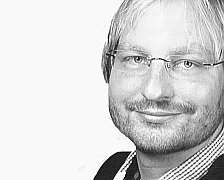
Head of Research Department Spatial Capital
// +49 (0)209.1707-203

Born 1985. Master's studies in Human Geography, Economics and Political Science at the University of Potsdam, the Humboldt University of Berlin and the University of Nottingham. Since 2010 research associate at the Institute for Work and Technology in the research focus “Spatial Capital.” PhD completed in 2017 at the Chair of Economic Geography, Catholic University of Eichstätt-Ingolstadt, on the topic of corporate lending by regional banks compared with large banks. Since 2025, director of the research department spatial capital together with Stefan Gärtner.
Work / research focus:
- Financial geography, in particular regional banks and development, and public finance
- Educational regions / vocational education and knowledge transfer
-
Regional development / structural policy
Awards:
- 2006–2010 Merit scholarship, Studienstiftung des deutschen Volkes (German Academic Scholarship Foundation)
- 2013–2015 PhD scholarship, Studienstiftung des deutschen Volkes
- 2017 Doctoral Prize of the Eichstätt University Society (Eichstätter Universitätsgesellschaft e.V.) for outstanding scientific theses
Memberships:
- Arbeitskreis Geographische Handelsforschung
- VGDH (Verband für Geographie an deutschsprachigen Hochschulen und Forschungseinrichtungen)
- Alumni, Studienstiftung des deutschen Volkes
Projects (selection)
Engaging entrepreneurial ecosystems for the youth / Ecosys4you
Project run-time: 01.06.2023 - 31.05.2026- Project run-time: 01.07.2019 - 31.03.2022
Measuring diversity - Geographical diversity and regional banks in Europe / GDivEU
Project run-time: 01.06.2021 - 30.11.2021
English Publications (Selection)
| Year | Title / Citation | Document type | Links / Downloads |
|---|---|---|---|
| 2025 | 2025: Beyond start-up formation: Effects of entrepreneurial ecosystem support activities for developing lagging regions Citation: Flögel, F., Letonja, M., Meyer, K., Rabadjieva, M., Vilman, Z., Zhekova, R., Zlateva, M. & Butzin, A. (2025): Beyond start-up formation: Effects of entrepreneurial ecosystem support activities for developing lagging regions. Local Economy: The Journal of the Local Economy Policy Unit, 2025, 1-20. https://doi.org/10.1177/02690942241311805 | Document type: Journal article | Links / Downloads: |
| 2024 | 2024: Regional banks and economic resilience: the impact of the global financial crisis and COVID-19 on countries with decentralised and centralised banking systems Citation: Flögel, F. & Hejnova, T. (2024): Regional banks and economic resilience: the impact of the global financial crisis and COVID-19 on countries with decentralised and centralised banking systems. Finance and Space, 1 (1), 460-488. https://doi.org/10.1080/2833115X.2024.2418860 | Document type: Journal article | Links / Downloads: |
Show all Publications
Dr. Franz Flögel
Head of Research Department Spatial Capital
// +49 (0)209.1707-203
Jahrgang 1985. Magisterstudium der Humangeographie, Volkswirtschaftslehre und Politikwissenschaften an der Universität Potsdam, der Humboldt Universität zu Berlin und der University of Nottingham. Seit 2010 wissenschaftlicher Mitarbeiter am Institut Arbeit und Technik im Forschungsschwerpunkt Raumkapital. 2017 Abschluss der Promotion an der Professur für Wirtschaftsgeographie der Katholischen Universität Eichstätt-Ingolstadt zum Thema der Unternehmenskreditvergabe regionaler Banken und Großbanken im Vergleich.
Arbeits-/ Forschungsschwerpunkte:
- Finanzgeographie, insbesondere Banken und Raum, sowie öffentliche regionale Finanzen
- Wirtschaftsförderung / Regionalentwicklung,
- Konsumption / Einzelhandel
Auszeichnungen:
- 2006-2010 Leistungsstipendium der Studienstiftung des deutschen Volkes
- 2013 - 2015 Promotionsstipendium der Studienstiftung des deutschen Volkes
- 2017 Promotionspreis der Eichstätter Universitätsgesellschaft e.V. für herausragende wissenschaftliche Abschlussarbeiten
Mitgliedschaften:
- Arbeitskreis geographische Handelsforschung
- Verband der Geographen an deutschen Hochschulen
- Junges Forum der Akademie für Raumforschung und Landesplanung
- Alumni der Studienstiftung e.V.
Projects (selection)
Show list with all projectsEnglish Publications (Selection)
| Year | Title / Citation | Document type | Links / Downloads |
|---|---|---|---|
| 2023 | 2023: Injecting climate finance into SME lending in Germany: Opportunities for and limitations of regional savings and cooperative Banks Citation: Flögel, F. (2023): Injecting climate finance into SME lending in Germany: Opportunities for and limitations of regional savings and cooperative Banks. ZFW – Advances in Economic Geography, 2023, 13. https://doi.org/10.1515/zfw-2022-0011 | Document type: Journal article | Links / Downloads: |
| 2019 | 2019: Will FinTech make regional banks superfluous for small firm finance? Observations from soft information-based lending in Germany Citation: Beckamp, M. & Flögel, F. (2019): Will FinTech make regional banks superfluous for small firm finance? Observations from soft information-based lending in Germany. Economic notes: review of banking, finance and monetary economics, 48 (3), 1-20. https://doi.org/10.1111/ecno.12159Regional banks have a competitive advantage in that short distances to clients enable the use of soft information for superior lending decisions. If the ambition of FinTech start-ups to create superior screening and monitoring technologies materialises, this advantage would be diminished and regional banks would become superfluous for small firm finance. To explore this claim, the paper in hand analyses qualitative empirical data about the lending processes and rating system use of regional German savings banks. In essence, the results from participant observation and interviews clarify the importance of “real” soft information for critical lending decisions. The context specificity and limited verifiability of “real” soft information hamper it from being hardened through the use of rating systems and other bank-ICT. Though FinTech's scoring technologies may overcome the first limitation, it appears likely that in the course of scoring development “real” soft information will be systematically crowded out due to the manipulation problem. The paper expects improved access to finance for SMEs if FinTech solutions overcome both limitations of “real” soft information use, or if peer-to-peer lending and regional banks coexist. Deteriorated access to finance is expected if FinTech companies displace the relationship banking of regional banks due to enhanced competition, without preserving the advantages of “real” soft information with superior screening and monitoring technologies. The paper concludes with recommendations on how to prevent deteriorated access to finance for small firms by promoting fair competition and FinTech innovations. | Document type: Journal article | Links / Downloads: |
| 2018 | 2018: Distance and modern banks’ lending to SMEs: ethnographic insights from a comparison of regional and large banks in Germany Citation: Flögel, F. (2018): Distance and modern banks’ lending to SMEs: ethnographic insights from a comparison of regional and large banks in Germany. Journal of economic geography , 18 (1), 35-57. | Document type: Journal article | Links / Downloads: |
Show all Publications